The real heroes of Operation Sindoor were not the armed forces or political leadership, but the ordinary citizens of India who refused to fall into the trap of communal provocation, asserts Colonel Anil A Athale (retd).
India expects Turkiye to strongly urge Pakistan to end its support to cross-border terrorism, said ministry of external affairs spokesperson, Randhir Jaiswal during the weekly briefing on Thursday.
11, 13, 15 are not some random odd numbers but the number of days that Prime Minister Narendra Modi took to act against Pakistani terror strikes on Indian soil.

Pakistani drones were intercepted by Indian air defence in Jaisalmer. Explosions were heard and flashes seen in the sky.

India has warned Pakistan against its unprovoked firings along the Line of Control (LoC) in Jammu and Kashmir as the directors general of military operations of the two armies spoke on the hotline amid the escalating tensions over the Pahalgam terror attack.

'Saudi-Pak defence pact is to anchor the defence and security of Saudi Arabia and not Pakistan, per se, with Islamabad being the junior partner.'

Abdullah, who visited the shelling-affected areas of Uri, including Salamabad, Lagama, Bandi and Gingal in north Kashmir's Baramulla district, also said that he would take up the demand for building individual bunkers in these areas with the Centre.

President Droupadi Murmu addressed the nation on the eve of Independence Day, praising the response to terrorism, highlighting achievements in defense self-reliance, and emphasizing unity and progress.
In the last 11 years, India and the world witnessed what he stood for, what he promised and did not deliver, and what he actually stood for and practised without fearing how history would judge him. Modi's tenure has been punctuated with headline-grabbing decisions, symbolic gestures, and stage-managed moments that continue to define his leadership and India's politics, points out Ramesh Menon.

Meanwhile, a precautionary blackout has been enforfced in the multiple areas amid the esclating tensions between India and Pakistan.

India has to fill in all the critical gaps in missiles, ammunition, sensors and stockpile in the fastest possible manner, focusing on the critical instruments that worked this time, asserts Shekhar Gupta.

Following the Pahalgam terror attack, the Indian Army launched Operation Sindoor, targeting Pakistani terror infrastructure and posts in the Poonch sector of Jammu and Kashmir. Over 600 artillery shells were fired in three days, decimating 20 Pakistani posts used for infiltrating terrorists into India. The precision strikes crippled enemy logistics, material, and morale, prompting retaliatory attacks by Pakistan on civilian areas. Despite the retaliation, Indian Army officers described the operation as a success, highlighting the high morale of the troops and the effective coordination between artillery and air defense units. The article details the intensity of the artillery shelling and the impact on both sides, highlighting the strategic significance of the Poonch sector and the ongoing tension between India and Pakistan.
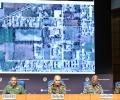
'We completely destroyed at least three posts, an ammunition depot, fuel storage facility, and gunnery, among other targets. Our retaliation was so devastating that it will take Pakistan at least 8-12 months to rebuild, possibly longer'
'We do not want to fall into a trap of uncontrolled escalation or all out conflict.' 'When the need arises we will do that.'

This came after Pakistan People's Party chairman Bilawal Bhutto Zardari on Saturday stated that Pakistan's Prime Minister Shehbaz Sharif had tasked him to lead a delegation to present Pakistan's case on the recent escalations of tensions between the two nations.
'Unlike the surgical strikes and the Balakot air strikes across the LoC, we have gone further inside Pakistan and raised the bar of escalation.'

John Spencer, the chair of Urban Warfare Studies at US-based think-tank Modern War Institute, said India showcased its ability to strike any target in Pakistan "at will" and drew and enforced a "new red line" for cross-border terrorism under the operation that was launched early on May 7.
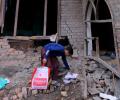
Amid escalating tensions between India and Pakistan, the US has said it will not get involved in the conflict, stressing that it is "fundamentally none of our business." While acknowledging concerns about a potential nuclear war, Vice President J D Vance emphasized that the US cannot control India and Pakistan, but can encourage them to de-escalate. The US has also reiterated its support for direct dialogue between the two countries and encouraged efforts to improve communications.

Authorities in Jammu and Kashmir on Sunday asked border villages residents, who were evacuated to safer places in view of cross border shelling by Pakistan, not to rush back to homes as they are yet to sanitise and clear these areas of any unexplored shells.

The troops were on patrol duty when one of the soldiers accidentally stepped over the landmine near Khamba Fort in Nowshera sector around 10.45 am, triggering the explosion.
The troops returned fire and reinforcements were rushed to neutralise the terrorists, the officials said, adding that a search operation is underway in the area.

It is considered one of the most crucial appointments within the Indian Army, according to an official statement from the Ministry of Defence.

India has accused Pakistan of breaching an understanding reached earlier on Saturday to stop military actions. Foreign Secretary Vikram Misri said there have been repeated violations of the understanding since the evening, and that the Indian armed forces are giving an appropriate response.
'Right now, we have no relationship with Pakistan. And the relationship with China is not great.'

US President Donald Trump has called for an end to the escalating tensions between India and Pakistan, expressing concern over the situation and offering to help resolve the conflict. Trump said he wants to see the two countries "stop" and work it out, adding that he has "good relationships" with both nations. He said he hopes the hostilities will end "very quickly", expressing sadness over the situation.
'Indian Army officers always lead their men into battle or combat. Pakistani officers are seldom seen at the front.'
The officials said dozens of unexploded explosives were destroyed by the experts along the Line of Control in Rajouri and Poonch districts and along the International Border in Jammu and Samba which witnessed intense cross-border shelling and drone attacks from May 7 to May 10.

India and Pakistan on Friday held a flag meeting along the Line of Control (LoC) in Jammu and Kashmir's Poonch district in an effort to ease tension after several recent incidents of cross-border firing and an IED attack, official sources said.

India on Tuesday firmly told Pakistan to uphold the sanctity of the Line of Control in Jammu and Kashmir in the backdrop of the recent firing incidents over which the two countries engaged in a blame game.
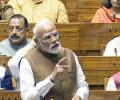
What was the aim of Operation Sindoor? Why was the operation halted so soon? asks Lieutenant General Prakash Katoch (retd).

A former Pentagon official, Michael Rubin has said that India targeted terror infrastructure with precision, and it was able to blunt Pakistan's response following the recent strikes.
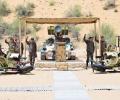
'War is not an answer. War is not a solution.' 'Deterrence is a solution. We should have the stick with us with which we can beat Pakistan.'

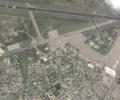
Pakistan military spokesperson Lieutenant General Ahmad Sharif Chaudhry told a hurriedly called press conference in Islamabad at around 4 am that th Pakistan air force's Nur Khan (Chaklala, Rawalpindi), Murid (Chakwal) and Rafiqui (Shorkot in Jhang district) airbases were targeted.

'The Indian Army, despite facing extreme weather conditions -- from searing heat in the summer in Rajasthan to bone-chilling cold in the winter in Ladakh, J&K, Himachal, Arunachal Pradesh and Sikkim -- remains steadfast in its duty.'
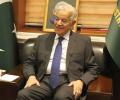
Last week, Information Minister Atta Tarar had said that 24-36 hours were important, fearing a possible strike by India. However, the time passed and there was no action by India.
Prime Minister Narendra Modi defended India's actions against terrorism, stating no country stopped India and criticizing the Congress party for not supporting the armed forces. He highlighted the success of Operation Sindoor and warned Pakistan against further misadventures.
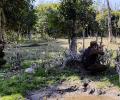
An Army Junior Commissioned Officer (JCO) was killed in an encounter with terrorists along the Line of Control (LoC) in the Akhnoor sector of Jammu and Kashmir. The terrorists' infiltration attempt was thwarted, but the JCO succumbed to injuries sustained during the encounter. This incident comes after a recent brigade commander-level flag meeting between India and Pakistan to discuss border management, highlighting the ongoing security challenges in the region.
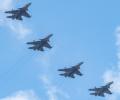
Pakistani military targets at Rafiqui, Murid, Chaklala, Rahim Yar Khan, Sukkur and Chunian were engaged using air-launched precision weapons from Indian fighter jets and the retaliation largely focused on command and control centres, radar sites and weapon storage areas, Qureshi said.
'Pakistan is economically very weak and will not be able to sustain a war for long.'
The launch of the first-ever direct train service from Delhi to Kashmir would be a big turning point in the Valley's mood and its integration with India. He had to thwart it at any cost, asserts Shekhar Gupta.
